Retrospective label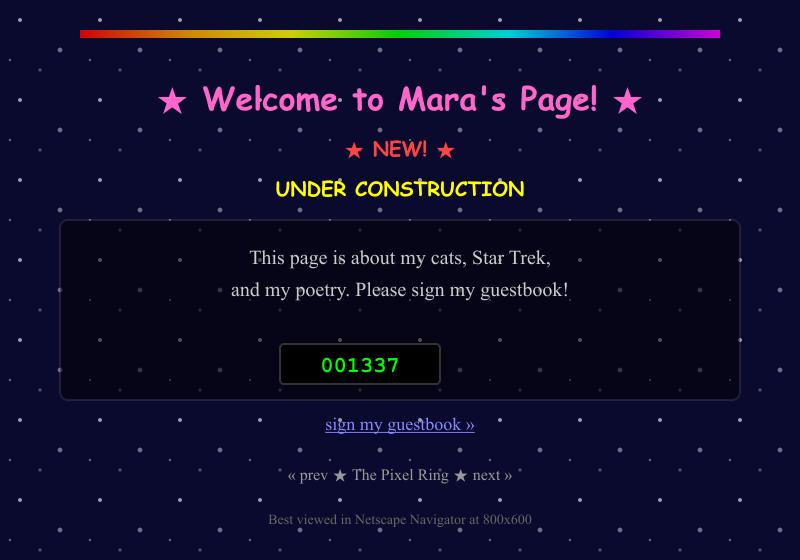
Vernacular Web
Named by net artist Olia Lialina in her 2005 essay 'A Vernacular Web' for the amateur personal pages of the mid-90s — the look existed a decade before its name.
Defining Signals
- Tiled background texture — a small image repeated edge to edge (starry night sky, clouds, marble) as wallpaper
- Animated GIF ornaments — twinkling sparkles, spinning @ signs, flaming rules, striped UNDER CONSTRUCTION signs
- Collected badges and counters — visitor counter, guestbook links, webring prev/next buttons, 'best viewed in Netscape' badges
- Default type, loud accents — system serif or Comic Sans, centered, with rainbow horizontal rules and multicolored emphasis
Overview
What makes this style what it is.
The Vernacular Web is the folk architecture of the early web: personal homepages built by amateurs from collected materials — tiled star backgrounds, animated sparkle and flame GIFs, rainbow divider rules, 'welcome to my home page' banners, visitor counters, guestbook links, under-construction signs, and webring badges. It is decorative, personal, and sincere: every ornament was chosen because its owner loved it, not because a system prescribed it.
Style brief — paste into your agent
Build the UI using the Vernacular Web aesthetic. This is the folk architecture of the early web: personal homepages built from collected materials. Tiled background textures — a small image repeated edge to edge (starry night sky, clouds, marble) as wallpaper. Animated GIF ornaments — twinkling sparkles, spinning @ signs, flaming rules, striped UNDER CONSTRUCTION signs. Collected badges and counters — visitor counter, guestbook links, webring prev/next buttons, 'best viewed in Netscape' badges. Default type with loud accents — system serif or Comic Sans, centered, with rainbow horizontal rules and multicolored emphasis.

CSS starting points:
- Tiled background: background: url('stars.gif') repeat; or background: url('marble.jpg') repeat;
- Rainbow rule: border: 0; height: 4px; background: linear-gradient(90deg, red, orange, yellow, green, blue, indigo, violet);
- Centered text: text-align: center; font-family: 'Comic Sans MS', 'Times New Roman', serif;
- Marquee: <marquee>Welcome to my homepage!</marquee>
- Visitor counter: <img src="counter.gif"> or a GIF-style counter image
- Badges: <img src="best-viewed-netscape.gif"> <img src="geoCities.gif">
- Links: <a href="guestbook.html">Sign my guestbook!</a> with colored text

Do not drift into Web Brutalism: the Vernacular Web is decorated with love — wallpaper, sparkles, badges, a counter. Web Brutalism strips all decoration and exposes bare HTML. Do not drift into Y2K: Vernacular Web materials are homemade and collected, personal and amateur. Y2K is synthetic futurism — chrome, gel plastic, iridescent blue-silver. Preserve text readability (even if the aesthetic is chaotic), ensure links are distinguishable, and provide visible focus rings.
Origin
The mid-1990s free-hosting web — GeoCities, Angelfire, Tripod — where millions of first-time authors decorated pages from shared GIF collections. Olia Lialina documented and named the culture in 'A Vernacular Web' (2005) and, with Dragan Espenschied, preserved a terabyte of GeoCities before its 2009 shutdown.
Often Confused With
This is the Vernacular Web because the page is decorated with love — wallpaper, sparkles, badges, a counter — by an amateur showing off their collection. It would become web brutalism if all decoration were stripped and the bare HTML skeleton — default type, blue links, no ornament — were exposed as a deliberate designer statement. Vs Y2K: this is the Vernacular Web because the materials are homemade and collected, personal and amateur.
Related Styles
Explore connected design movements.